



Water is an important part of Riverside Park’s character, but it also presents some of the Park’s greatest challenges.
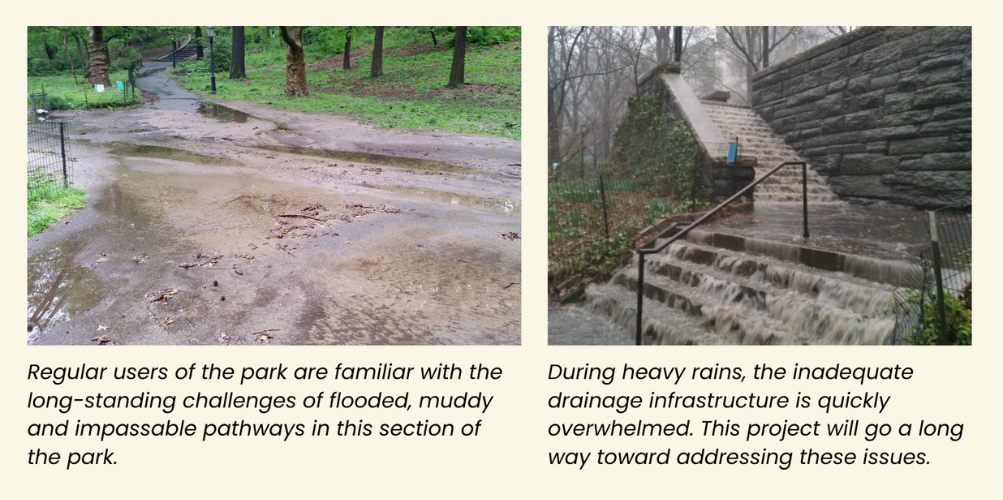
The Park’s steep river-facing slopes, aging drainage infrastructure, and increasingly intense storms contribute to erosion, flooding, and persistent ponding between 108th and 116th Streets. After years of planning and study, a major project is now underway with NYC Parks to address these issues and create a more resilient landscape.
Much of the work so far has happened below the surface, with crews replacing nearly 90-year-old drainage infrastructure, adding new catch basins, and improving how stormwater moves through the landscape. Above ground, visitors will eventually see newly paved paths, erosion-control measures, and new wet meadows planted with native species.
We caught up with Margaret Bracken, Landscape Architect for NYC Parks and Chief of Design & Construction at Riverside Park Conservancy, and John Herrold, Riverside Park Administrator for NYC Parks and Senior Advisor to the Conservancy, about the progress so far and what’s next for the project.
Can you describe the work that has been done so far?
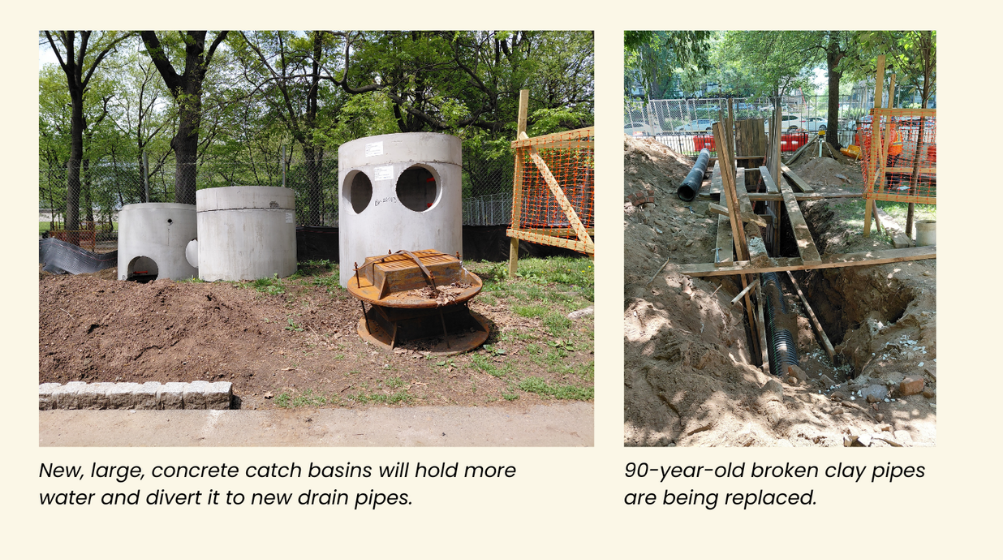
M: The work completed so far has mostly focused on the upper path which runs immediately west of the massive mica-shist Olmsted wall. A significant amount of that work has been underground so not necessarily visible but important to addressing the major goal of the project which is to replace the deteriorating drainage infrastructure in the park from W108th st to W116th street and resulting flooding and constant ponding at various locations in that area. Many of the drainage structures are 90 years old and the existing clay drainage pipes are frequently broken or damaged by root infiltration. These damaged structures have been replaced and additional drainage structures have been added.
J: In addition to increasing the number of drains, existing drains are being replaced with larger drain covers atop much larger catch basins. These are reservoirs that can hold a large volume of water until the drain pipes can carry it away, so it doesn’t overflow into the landscape.
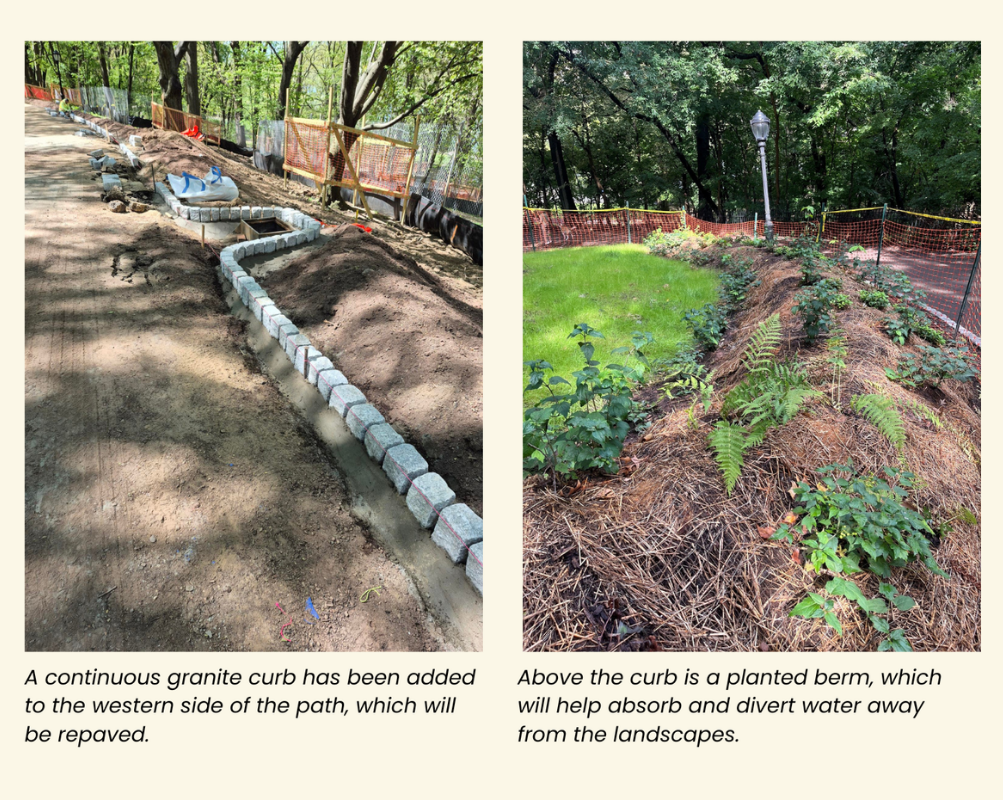
 M: In order to better contain the water, a continuous granite curb has been added along the western side of the path, with an adjacent planted berm immediately to the west. This will help to prevent the erosion caused by rain water running down the slope and will, through improved grading, direct it to the new drainage structures.
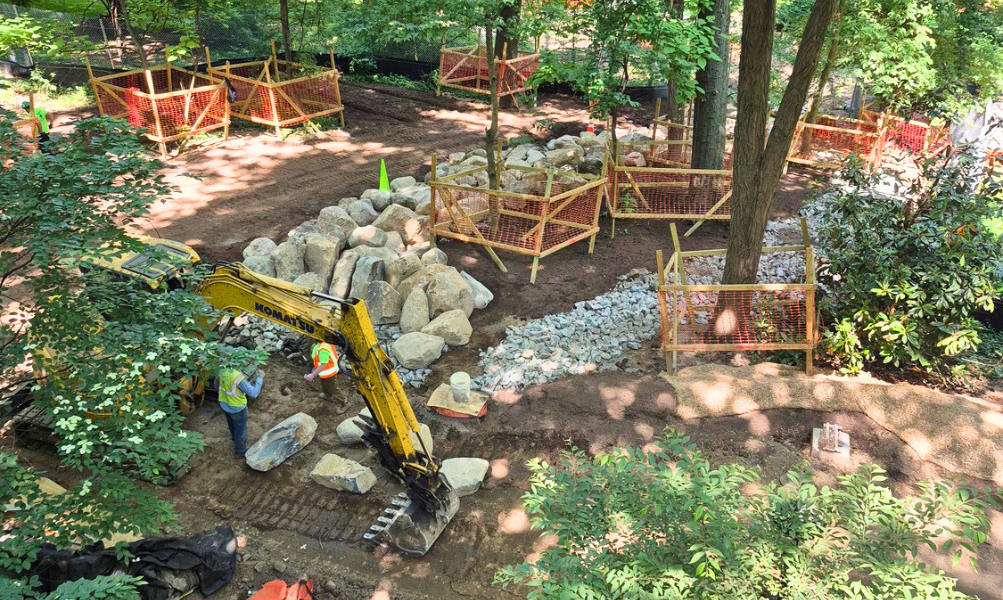
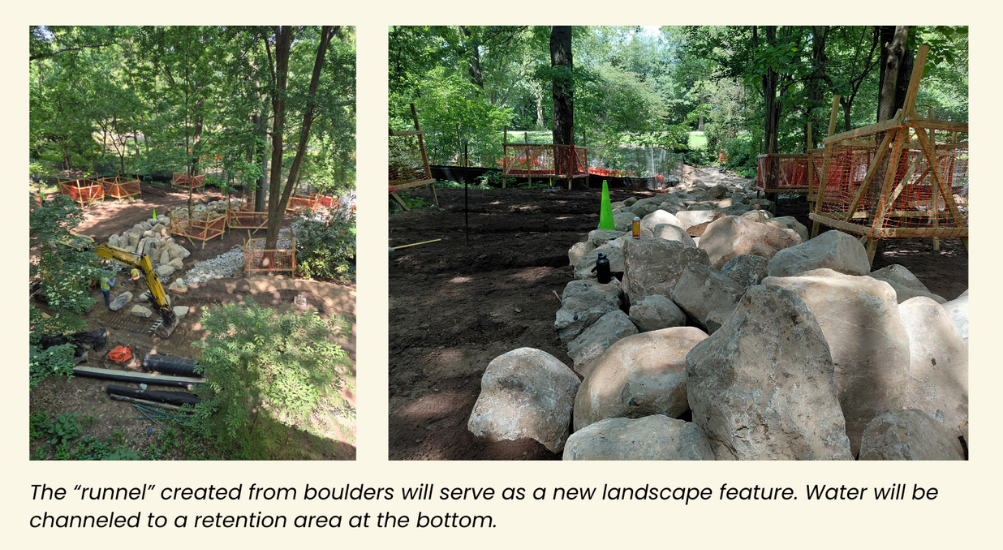
 M: The most unique feature of the upper path work is the inclusion of a boulder runnel which was placed at a low point prone to extreme erosion resulting in a persistent gulley. This area has been filled with drainage material which will channel the storm water into a retention area at the toe of the slope. Paving will be completed at the upper path this fall and it will reopen later this year. Simultaneously, the contractor has been working on replacing drainage structures on Riverside Drive with paving to follow.
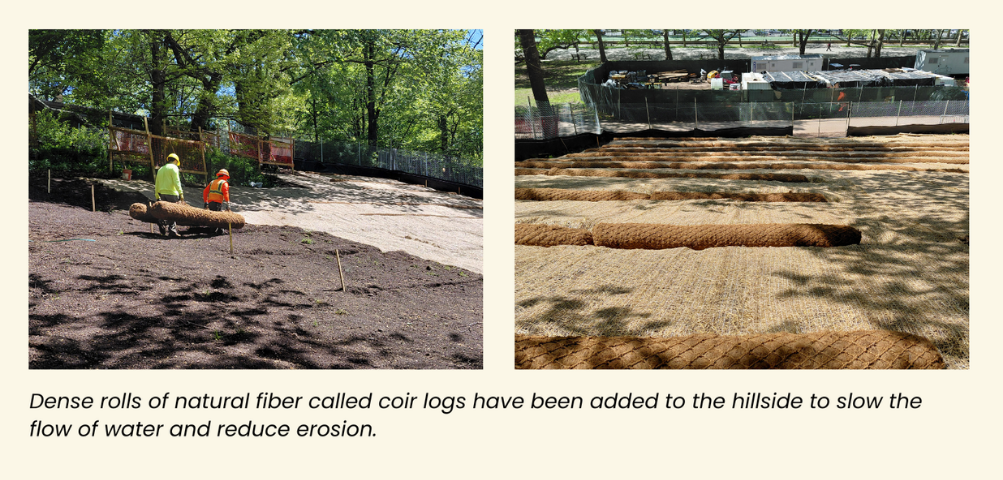
 J: Other erosion control efforts include rows of “coir logs” embedded in the hillside lawns that in the past have frequently washed out. Coir logs are dense rolls of natural fiber material that slow the flow of water, increasing absorption, and hold the soil in place.
 Approximately what percentage of the total project has been completed so far?
M: Approximately 35% of the project has been completed so far.
What are you most excited about in the new drainage design?
M: We are very excited about replacing 90 year old drainage infrastructure and, crucially, returning the interior park paths to a newly paved condition. Most of the asphalt walkways north of 108th st have been almost impassable for many years so replacing the asphalt pavement will be a huge improvement for all who use and maintain Riverside Park. It’s such a beautiful area of the park and we will be able to enjoy it again without tiptoeing through mud.
 What are some of the biggest challenges that the team has had to navigate in performing the work?
M: The biggest challenge was most definitely working around our 90 year old tree canopy. One of the greatest assets of Riverside, is our mature tree canopy which brings shade, filters air pollutants, creates habitat, absorbs run off and keep us all sane so we were very aware of the need to protect those trees. Many of the existing drainage lines, installed before the tree canopy was planted, run very close by the critical root zone of those mature trees. Wherever possible, new and replacement drainage lines were relocated away from tree roots. In some cases, with minimally damaged lines, we were able to retain those pipes by using an interior felt and epoxy liner which adheres and hardens to form an interior coating on the existing pipe. Weather can also be challenging, the storm water that is the root cause of the work, can also make construction challenging.
What’s next for the project? What can Riverside Park visitors expect to see happening this fall and winter at the project site?
M: This fall, we’ll see the completion of the paving at the upper path which will then reopen. Additionally, planting will begin at 4 wet meadow locations at 108th, 112th, 114th St and 116th Street. Those areas that suffer from frequent standing water and will be planted with a native perennial palette of material that will thrive in persistent wet conditions. From fall though spring 2027 work will continue on the lower path, including more essential drainage infrastructure and new asphalt pavement.
For a deeper look at the project’s background and goals, read our earlier post, Major Drainage Improvement Project Set to Begin Construction in Fall 2025.